
Published on October 21, 2026
The project has been running for months. The department has defined its requirements, spoken with potential suppliers, and internally already has an idea of what the solution should look like.
Then comes the shopping, and it means:
„"Could you negotiate the price again?"“
I've often experienced situations like this in very different companies. And of course, it's frustrating. Because by that point, many of the really big levers have already been taken.
But at some point I started to turn the question around:
Why should the department have involved purchasing earlier?
Early involvement must have a reason.
The usual answer is: Because the purchasing department needs to be involved earlier.
But that doesn't necessarily help.
A developer, IT manager, or production manager doesn't bring another function into their project earlier simply because the organizational chart dictates it. They do so when that function helps them solve their problem more effectively.
In my view, this is precisely where a weakness of many purchasing organizations lies.
They expect the specialist departments to recognize their strategic value. The more important question, however, is whether procurement truly understands the goals and problems of the specialist departments.
For a developer, a particular technology can be crucial. For production, it's security of supply. For IT, it's speed. For finance, it's profit and cash flow.
Anyone who talks primarily about tender rules, approvals and savings in this situation will quickly be perceived as an additional process instance.
And legal bodies are often only brought in when they are needed.
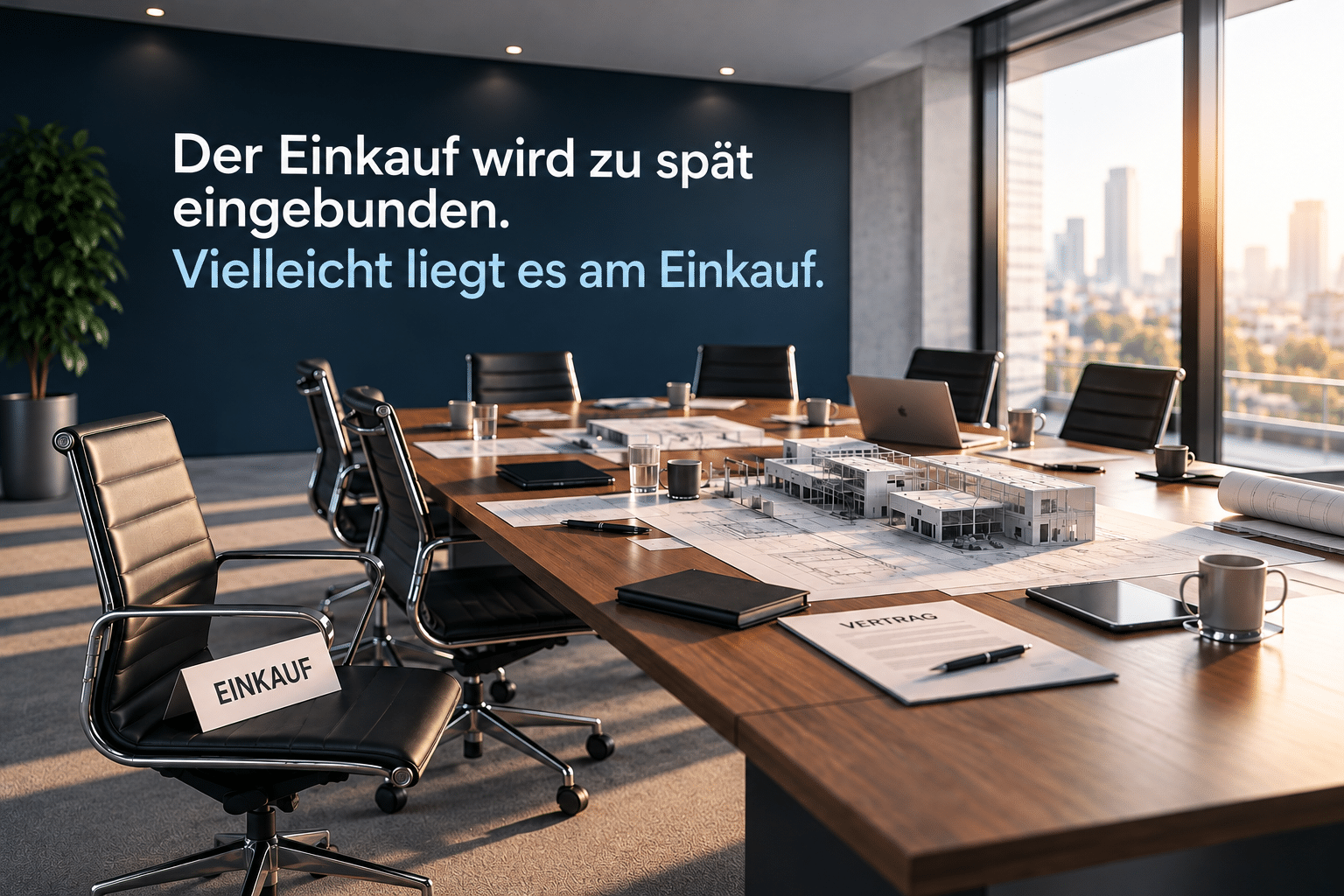
The greatest leverage often lies before the tender process.
This is particularly problematic because purchasing could contribute a great deal, especially in the early stages.
Even before a solution is found, completely different questions can be asked:
Do we need precisely this specification? What requirements are driving up costs? What risks arise from this? What alternatives does the procurement market offer? Are there other technologies or business models?
If the specifications, supplier, and solution are already largely determined, the scope for negotiation narrows. A good buyer might still be able to negotiate, but many fundamental decisions have already been made.
This creates a cycle:
The later purchasing is involved, the less it can contribute. The less it can contribute, the lower its perceived benefit. And the less reason there is to involve it earlier in the next project.
Only the purchasing department itself can break this cycle.
In my projects, I have repeatedly experienced that good procurement decisions rarely arise from a single perspective.
What good is the lowest price if the quality isn't right? What good is the technically best solution if it can't be reliably delivered? And what good is security of supply if costs spiral out of control?
That's why we at Emarticon work with the QLTC approach: quality, logistics, technology, and cost management are considered together. The purchasing department builds and moderates this cross-functional team.
The crucial point for me, however, is not the model itself.
It's about collaboration.
When purchasing, specialist departments, quality, logistics, and, if applicable, finance work together on a task early on, the role of purchasing changes. It doesn't just come in once all the essential decisions have been made. It contributes to making the decision better in the first place.
That, for me, is precisely what strategic purchasing entails.
Why this topic is becoming more important again
Current research shows that many companies are working on precisely this point.
BCG describes the necessary transformation in 2026 from a late-engaging "reactive gatekeeper" to a partner that collaborates with business and finance to shape requirements, specifications, and sourcing strategies.BCG Global)
Gartner also sees a crucial lever in the early stages: If procurement can already influence project requirements, costs, risks, and long-term supply can be better managed. If, on the other hand, it is perceived primarily as a cost-focused function that is insufficiently aligned with business priorities, it loses influence.Gardener)
What I find particularly interesting about this is that the discussion is no longer just about involving the purchasing department earlier.
The crucial question is what he needs to contribute to make others want him involved from the very beginning.
Three questions purchasing managers should ask themselves
Instead of just asking „How do we get the departments to involve us earlier?“, I would ask three other questions:
- Do we really know what problem the department wants to solve?
- Is there anything we can contribute before the specifications and suppliers are finalized?
- Does our involvement make the project better for the internal client – or initially just more complicated?
If the answers are convincing, part of the problem may solve itself.
For me, strategic purchasing doesn't start with sitting at the table earlier.
He begins by giving a good reason why he is brought to the table earlier.
Learn more about how Emarticon strategically develops purchasing organizations:
→ Strategic purchasing at Emarticon:
Do you want to make purchasing and supply chain a key factor for success?
I would be happy to discuss your specific situation with you in a personal conversation.