
Published on August 17, 2026
We talk about tariffs all the time.
I believe the real race is already happening elsewhere.
It's no longer just about products.
It's about knowledge. More precisely: about access to knowledge.
This is precisely where the rules of the game for European purchasing are changing.
China has significantly restricted the transfer of sensitive technologies and know-how abroad through new regulations. Companies will only be allowed to share this knowledge under strict government guidelines.
For me, this is far more than just another trade barrier.
It marks the end of a strategy that many European companies relied on for decades. For a long time, the roles were clearly defined: Europe brought technologies and manufacturing expertise to China. Those who wanted to produce there had to share their know-how. China used this knowledge, consistently developed it further, and today is among the innovation leaders in areas such as battery technology, electromobility, and artificial intelligence.
And it is precisely now that the direction of knowledge transfer is changing.
Access to this technological know-how is becoming more difficult. This affects not only individual companies, but also the competitiveness of entire industries.
Therefore, I am observing a trend in many procurement projects that is increasingly worrying me.
Purchasing decisions are still often defined primarily by prices, savings, and terms. This remains important – but it's no longer sufficient. The crucial question today is no longer:
„"Where can we buy our groceries more cheaply?"“
Rather:
„"How do we secure long-term access to technology, innovation and know-how?"“
In my view, this fundamentally changes the role of purchasing.
Purchasing is evolving from a classic cost function to a strategic future function. He is increasingly playing a key role in deciding which technologies will be available to a company in the long term, how resilient the supply chain is, and how independently a company can position itself in critical areas.
This also changes the requirements for supplier evaluation.
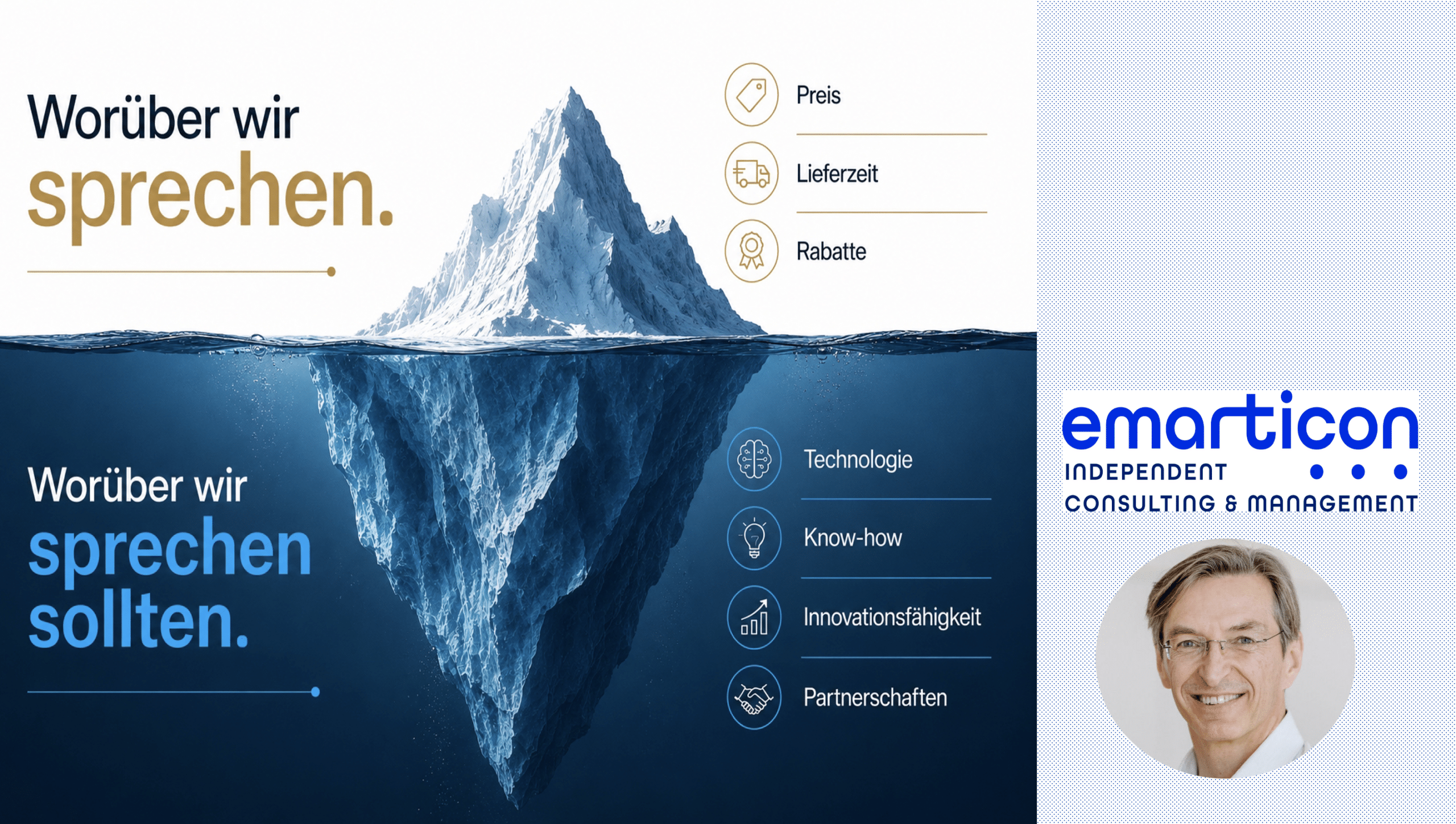
In addition to price, quality and delivery capability, new criteria are gaining importance:
- What technological expertise does a supplier possess?
- How innovative is he?
- What dependencies arise?
- Which strategic partnerships make sense?
- What knowledge should we consciously build up ourselves within the company?
I am convinced that successful purchasing organizations will have to think much more broadly in the future. Topics such as resilient procurement strategies, targeted know-how development and long-term technology partnerships are becoming central components of a modern purchasing strategy.
Perhaps that is precisely where the greatest change lies.
Today, procurement no longer just ensures a company's supply; it increasingly secures its future viability.
👉 More on this topic:
We at Emarticon show you how to make your purchasing future-proof with our high-achievement sourcing approach.
→ High-Achievement Sourcing:
Do you want to make purchasing and supply chain a key factor for success?
I would be happy to discuss your specific situation with you in a personal conversation.