
Published on August 9, 2026
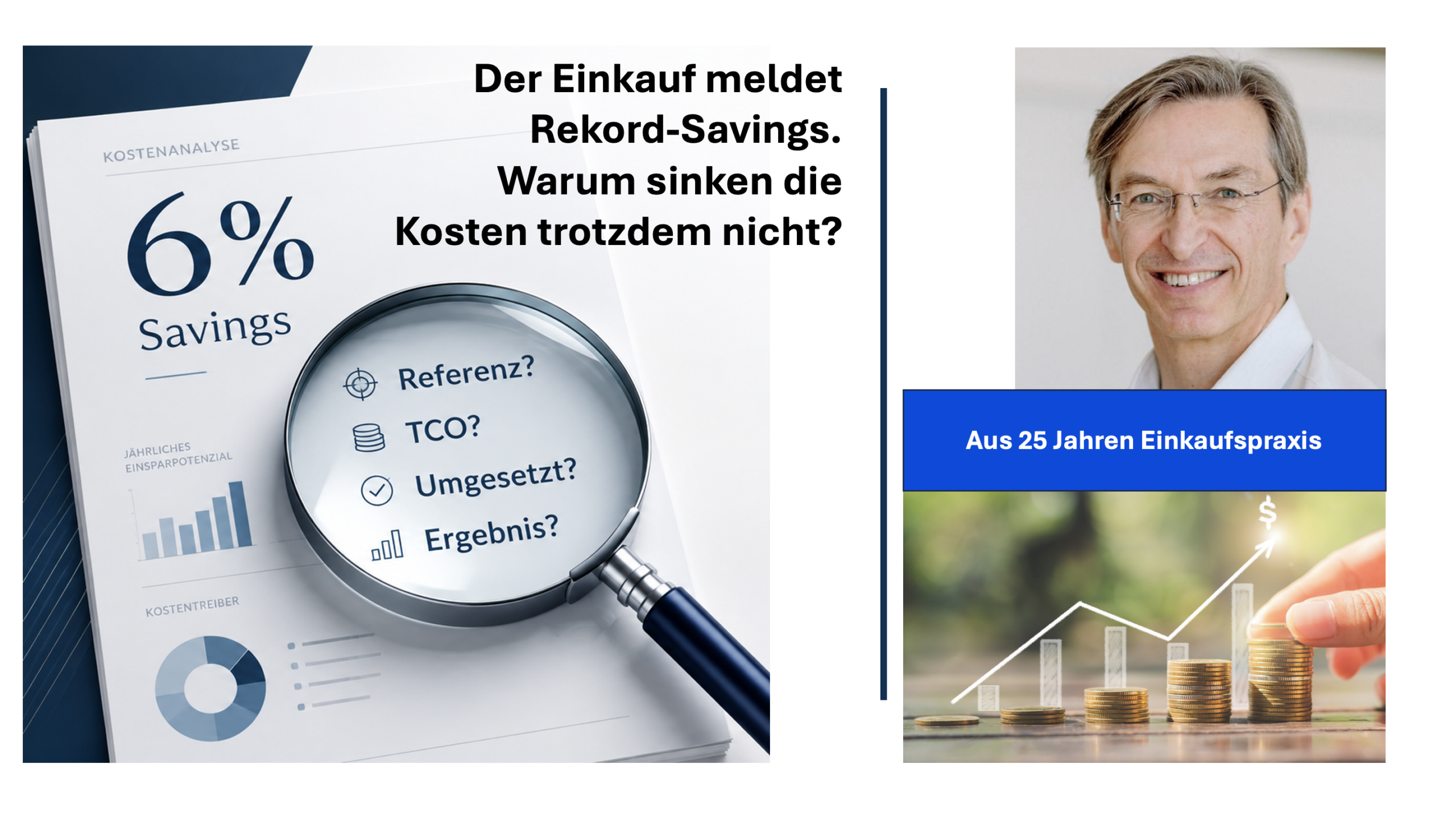
The purchasing department reports six percent savings. At the same time, costs are rising by two percent.
Both can be correct.
Let's assume a supplier announces a price increase of eight percent. After intensive negotiations, only two percent remain. The purchasing department has successfully fended off six percentage points of the announced price increase – and thus made a significant economic contribution.
Nevertheless, the company ends up paying two percent more than before.
Did the purchasing department save six percent? The answer varies depending on how you look at it. However, one thing is certain: the purchasing department avoided a significant portion of the threatened cost increase.
This may initially seem like splitting hairs. In fact, it leads to a central question in cost management:
What exactly are we measuring when we talk about "savings"?
What a savings figure really means
In procurement projects, I regularly encounter impressive savings figures. Ten percent here, several million there.
My first question is usually: Opposite what?
Because without a clear reference, a number says surprisingly little.
Was the calculation based on the previous price? On the supplier's initial offer? On a previously announced price increase? On the budget? On a market price? Or on a should-cost model?
Depending on the starting point chosen, the same purchasing measure can lead to completely different results.
Therefore, a savings figure without a clearly defined baseline and methodology is not a reliable control variable for me.
Cost avoidance and cost reduction are not the same thing.
The example of the averted price increase shows why clear terminology is important.
Cost avoidance means: Additional costs were avoided or limited.
Cost reduction means: Existing costs have actually been reduced.
Both can be highly relevant for a company. However, they have different economic effects.
Anyone who lumps both together under the umbrella term "savings" quickly produces impressive figures – and eventually a credibility problem.
The obvious question arises at the latest when purchasing, finance and management look at the results together:
Where did all the millions go?
From price to actual economic effect
Even a genuine price reduction does not automatically mean that the company's overall costs will decrease accordingly.
Quantities change. The product mix shifts. Freight costs increase. Payment terms change. Quality problems cause consequential costs. Inventories grow. Additional services are billed elsewhere.
A component can become ten percent cheaper and still cause higher overall costs.
Conversely, a supplier with a higher unit price may be the better economic solution over the entire product lifecycle.
Therefore, in strategic purchasing, it is not enough to simply look at the price.
The decisive factor is the Total Cost of Ownership – and ultimately the question of what economic effect it actually has for the company.
Five questions that every measurement of economic impact should answer
Therefore, in our projects at Emarticon, we do not start with the question: "How high should the savings be?"„
We're starting earlier.
1. What economic effect is actually intended to be achieved?
Is the goal a genuine price reduction? Cost avoidance? Lower overall costs? Adherence to defined target costs? Or, for example, better payment terms?
Not every situation requires the same target size.
2. Against which reference is the measurement being taken?
The baseline must be clearly defined and comprehensible to all involved. Without a common reference point, differing interpretations will emerge.
3. What should actually be agreed upon and implemented?
New prices and conditions must not only be negotiated, but also contractually agreed, stored in the systems and actually implemented in orders.
4. What can be achieved in reality?
This is where it's decided what remains of the calculated advantage. Quantities, product mix, logistics, quality, inventory, payment terms, and other factors can significantly alter the economic impact.
5. Where should the effect be visible within the company?
Is it possible to track when and how a measure affects costs, cash flow, or company results?
Only when these five questions have been answered can one assess what a savings figure actually means.
There is no universal metric for purchasing success.
But for me, the crucial point goes even further.
Companies need a clear definition of what commercial competitiveness means in their specific situation.
And this definition can look different.
For one company, sustainable cost reduction might be the primary focus. For another, it's crucial to avert a massive price increase. In one project, payment terms or liquidity play a major role. In another, target costs for a new product must be met.
A one-size-fits-all approach doesn't work here.
Anyone who measures purchasing performance solely by a single savings metric reduces a complex economic task to a number that, in the worst case, creates the wrong incentives.
Why communication is just as important as methodology
A clean measurement method alone is therefore not enough.
Within the company, there must also be a shared understanding of what is being measured and what a key performance indicator (KPI) means.
That sounds obvious. In practice, it isn't.
I have experienced situations where purchasing and management talked about the same figures – but understood them in completely different ways.
This can not only lead to false expectations, but also damage the credibility of the purchasing department and, in extreme cases, have personnel consequences.
Therefore, for me, professional cost management always includes clear internal communication:
What is our goal?
How do we measure it?
And what conclusion can we actually draw from this number?
Savings should not become an end in themselves
When purchasing organizations are primarily measured by reporting the highest possible savings, a problematic incentive quickly arises.
Then the key figure becomes the goal.
However, the real task of strategic purchasing is different: it is intended to secure and improve the company's commercial competitiveness.
This can be achieved through a lower price, by avoiding a price increase, through a technical change, through reduced inventory, through better payment terms, or through a more reliable supplier.
Of course, other corporate goals such as quality and security of supply also play a crucial role. However, they deserve separate consideration.
What companies can learn from this
Therefore, I would not ask:
„"How high are our savings?"“
Rather:
„"What economic effect do we want to achieve with the purchase – and can we track what has actually happened?"“
This question changes more than just the measurement method.
It changes the way purchasing, finance, and specialist departments collaborate. It changes goals and incentives. And it forces a company to define more precisely what contribution purchasing should actually make.
Because the most convincing savings figure is not the largest, but the one where the entire company has clarity about what it means – and what real economic effect it represents.
👉 More on this topic:
We demonstrate how savings potentials can be transformed into sustainable cost reductions with our Strategic Cost Reduction approach at Emarticon.
→ Strategic Cost Reduction in strategic purchasing:
Do you want to make purchasing and supply chain a key factor for success?
I would be happy to discuss your specific situation with you in a personal conversation.