
Published on October 28, 2026
A critical component comes from a single supplier. The analysis shows that if this supplier fails, production could come to a standstill in the worst-case scenario.
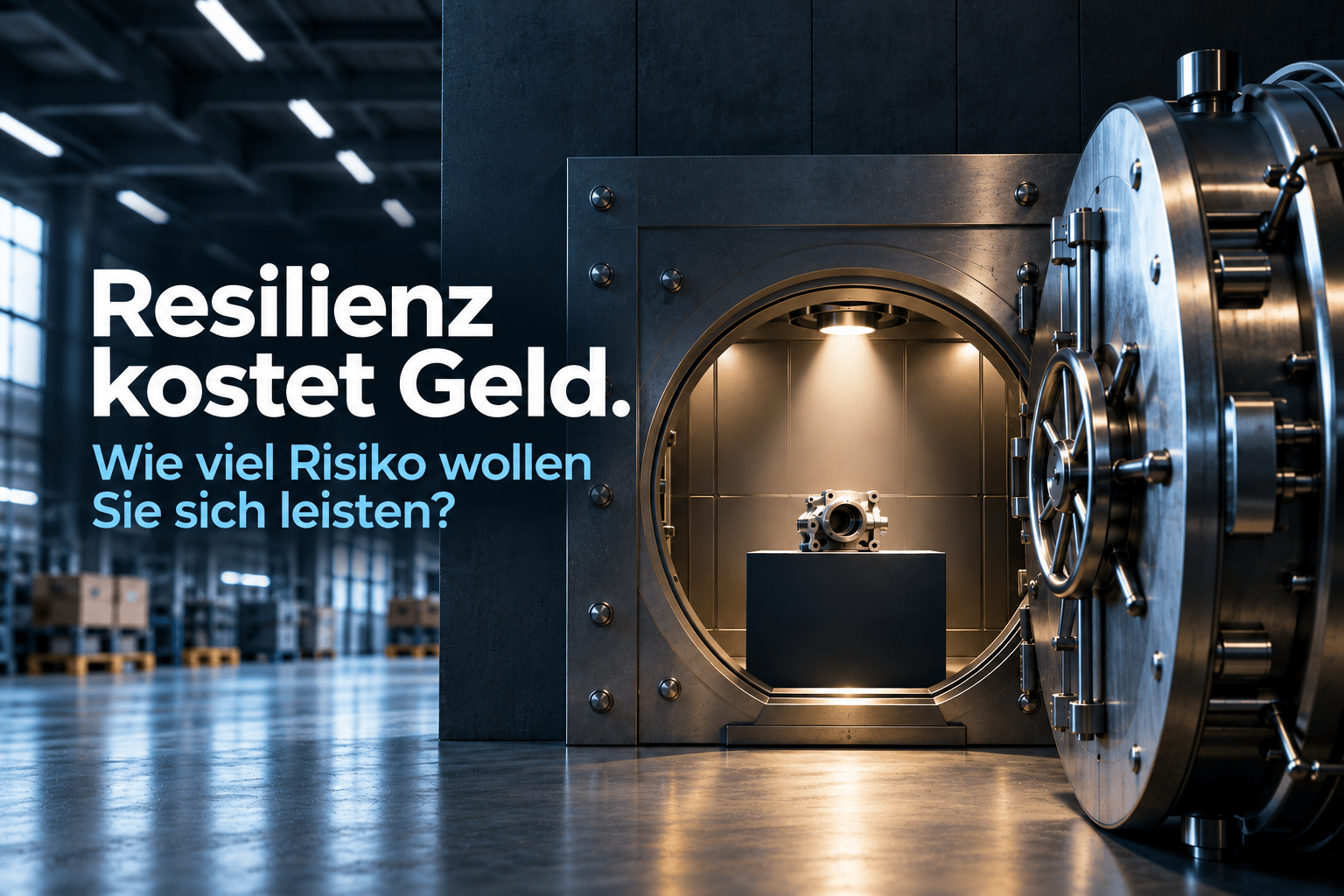
The solution seems clear: a second supplier, additional tools, more stock.
The risk decreases.
And then comes the bill.
Suddenly, security of supply costs additional money, ties up capital and may make purchasing less efficient.
It is precisely at this point that risk management becomes a management decision.
Maximum resilience sounds good.
However, hardly anyone wants to pay for it.
Every avoided risk comes at a price.
In my projects, I experience an understandable reflex: as soon as a relevant risk becomes apparent, we want to eliminate it.
But a company cannot eliminate every risk – and it shouldn't try to.
A second supplier can eliminate economies of scale and volume bundling. Additional inventory ties up working capital. Alternative production capacities must be built and, in some cases, maintained. A regional supplier may be more expensive than the existing one.
All of these measures may be correct.
But not for every part, every supplier, and every risk.
For me, the crucial question is therefore not: How can we become as resilient as possible?
Rather: What kind of resilience do we need – and what price should we pay for it?
Geopolitical risks have an economic impact
This question has become even more urgent in 2026.
69 percent of investors surveyed by McKinsey rank geopolitics among the three most important macroeconomic issues for their investment decisions. An equal number express serious concern about geopolitical instability. International conflicts are also most frequently cited in the study as an underestimated risk by the market.McKinsey & Company)
The picture becomes even more concrete when looking at companies. Of the firms that are particularly affected by trade barriers, 77 percent expect negative effects from current tariff developments on their EBITDA. 17 percent even anticipate declines of more than eleven percent.McKinsey & Company)
Tariffs, export controls, sanctions, or political conflicts are therefore no longer abstract risks. They can directly impact delivery capacity, costs, and profitability.
BCG therefore recommends a "Cost of Resilience" approach to companies: Supply and production networks should be able to react to disruptions without losing margin or competitiveness.BCG Global)
This balance is crucial.
The problem begins when everyone optimizes their own goal.
The supply chain manager wants security of supply.
The purchasing department wants competitive terms.
Production requires stable availability.
Finance wants to reduce working capital.
Each of these requirements is justified.
Things get difficult when each function optimizes its own goal.
Then the supply chain builds up additional inventory, while finance is simultaneously supposed to reduce tied-up capital. Or purchasing consolidates as much volume as possible from one supplier, while risk management aims to reduce dependencies.
The right decision often lies somewhere in between.
Therefore, I don't consider resilience to be solely a supply chain issue. It's a business decision that weighs risk against profitability.
Accepting a risk can be the right decision.
That may sound inconvenient at first. But that, for me, is precisely what professional risk management entails.
Not every identified risk needs to be, and indeed can be, eliminated.
Therefore, when faced with significant supply chain risks, I would ask three questions:
- What will the risk cost us if it materializes?
- What will it cost us to reduce this risk?
- What residual risk are we willing to accept?
I consider the third question to be particularly crucial.
Not every risk justifies the same level of effort. If a critical component fails and production is halted for weeks, even expensive insurance can be economically worthwhile. However, if another component can be replaced quickly, the same effort might be disproportionate.
Resilience therefore does not mean hedging against every risk to the maximum extent. It means investing where the potential consequences justify hedging.
Risk is part of economic decision-making.
At Emarticon, we therefore expanded the classic triangle of performance, cost, and time years ago to include a fourth dimension: risk. Because risk also has economic value.
A procurement decision may appear particularly advantageous on paper – and become very expensive if a critical dependency becomes a problem. Conversely, maximum hedging can cost so much that it bears no reasonable relation to the actual risk.
The task of risk management lies precisely between these two extremes.
It's not about avoiding as many risks as possible. It's about making conscious decisions: Which risks can we bear? Which should we reduce? And for which risks would the consequences be so severe that we cannot afford them?
No supply chain will be completely crisis-proof.
But it can be as resilient as is economically sensible and necessary for the company.
👉 More on this topic:
Learn more about how Emarticon makes risks in purchasing and supply chain transparent and helps companies balance cost efficiency and resilience:
→ Supply chain risk management
Do you want to make purchasing and supply chain a key factor for success?
I would be happy to discuss your specific situation with you in a personal conversation.