Published on September 18, 2026
More than ten million dollars.
A global pharmaceutical company discovered this much "value leakage" when it systematically compared invoices with the agreed contract terms. The company used an AI-based tool for this purpose. According to McKinsey, the proof of concept was developed within just four weeks. Subsequently, supplier negotiations were initiated to recover the lost value.McKinsey & Company)
What impressed me about this example was not so much the technology, but the sheer scale.
Because the terms were stipulated in the contracts. Nevertheless, the agreed value apparently did not reach the company in full.
This is precisely one of the challenges that is easily underestimated in contract management.
The real work begins after the signature.
In my professional life, I have negotiated and managed very large contracts, particularly in the IT and outsourcing sectors. For example, at a major German bank, I was responsible for the operational and strategic management of an IT outsourcing project with a contract volume exceeding €120 million. At an insurance group, the contract volume was over €300 million.
At such scales, a great deal of energy is rightly invested in negotiation. Prices, services, service levels, liability, contract durations, and adjustment mechanisms must be clearly defined.
But eventually, it will be signed.
The project team is disbanding. The negotiators are moving on to the next task. In day-to-day operations, other people continue working with the supplier.
The true value of the contract will only be determined now.
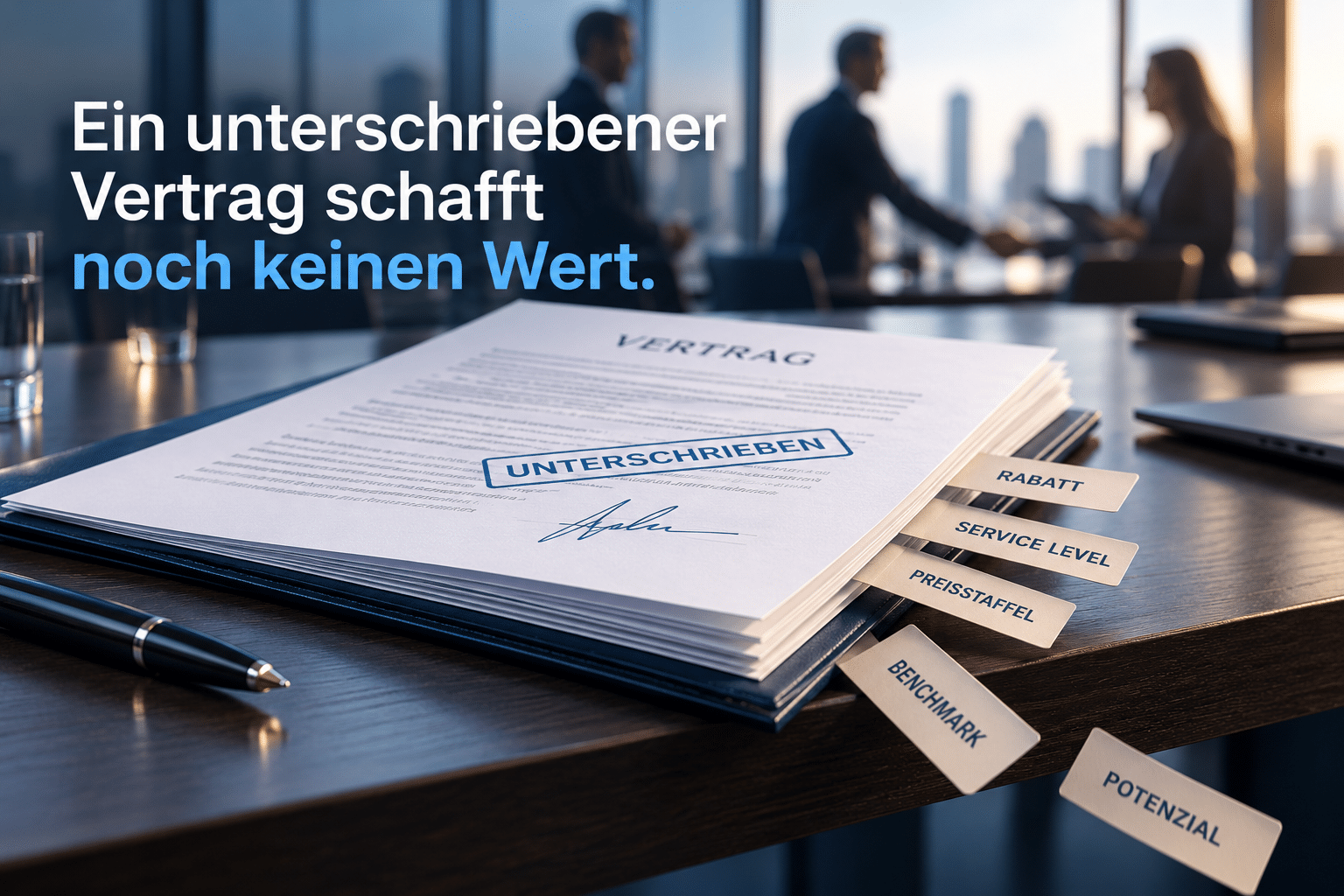
Contract and reality can drift apart.
What's written in the contract and what actually happens in everyday life are not always the same.
An agreed-upon price scale is not fully applied. A discount is not claimed. A service level is not met without the intended consequences being taken. Benchmarking or renegotiation rights remain unused.
And the cause is not always with the supplier.
The company itself can also contribute to this: quantities are not bundled as planned, services are ordered outside of agreed processes, or forecasts are not delivered.
This can lead to a loss of economic value, even though the relevant regulations are already included in the contract.
Who bears the responsibility after the signature.
For me, this is one of the crucial questions in strategic contract management.
I don't mean: Who manages the contract? Who monitors the notice period? Who is formally designated as the responsible party?
But rather: Who ensures that the company actually receives what was agreed upon over the entire term?
Depending on the contract, this could involve purchasing, a specialist department, finance, IT, or a dedicated contract management team. The crucial factor is not so much the organizational solution itself, but rather clear accountability.
For me, active contract management therefore primarily means regularly comparing three things:
- What did we agree on?
- What do we actually receive and what do we pay for?
- Where do we need to make adjustments?
AI can make deviations visible
That's precisely why I find the aforementioned pharmaceutical case so interesting.
Technology now makes it possible to systematically compare large quantities of contract terms, orders and invoices – an effort that would be almost impossible to manage manually.
This opens up new possibilities for detecting value leakage early.
McKinsey describes this approach as part of a development in which leading purchasing organizations are increasingly considering value creation across the entire source-to-pay process – and not just looking at the commercial terms at the time of contract signing.
But technology alone will not solve the problem.
It can make a deviation visible. What follows from that remains a management decision.
Not every deviation is automatically a mistake. A contract may run for years. Services, quantities, or general conditions can change.
Good contract management therefore means more than just monitoring compliance with a contract. It also means recognizing in time when adjustments need to be made.
Therefore, I would regularly ask three simple questions:
- Will we get the terms we agreed upon?
- Are we receiving the service we agreed upon?
- Are we using the rights and mechanisms we have agreed upon?
If a company cannot reliably answer these three questions, I would take a closer look at the contract.
Not necessarily because he's bad.
But because there might be value in it that no one is realizing.
A contract is a promise about a future outcome.
A signed contract is not yet an economic outcome. It initially describes what two parties have agreed upon for the future.
Whether the expected value actually results from this depends on the outcome.
Therefore, for me, contract management is not contract administration.
The negotiation determines the potential.
Contract management ensures that this becomes reality.
👉 Learn more about how Emarticon negotiates large and complex contracts and strategically manages them throughout their lifespan:
→ Contract management at Emarticon
Do you want to make purchasing and supply chain a key factor for success?
I would be happy to discuss your specific situation with you in a personal conversation.