
For over 25 years, I've been exploring the questions that truly advance companies in strategic procurement and supply chain management. In "Impulses," I share experiences from my project work, contextualize current developments, and challenge established ways of thinking. Not every new method delivers on its promises—and not every proven approach is still the right one today. My goal is to provide guidance, stimulate thought, and offer fresh perspectives.
Today's best supplier may be the wrong partner for tomorrow.
A supplier can receive top marks today – and still be the wrong partner tomorrow. This is because traditional supplier evaluations have a systematic weakness: they primarily look in the rearview mirror.
Quality, delivery reliability, costs, complaints – all these key performance indicators show how well a supplier has met requirements so far. That's important. But it doesn't answer the question that is at least as crucial for the future:

What skills can this supplier bring to the table for us tomorrow? This is precisely where strategic supplier management begins for me.
A strategy is only good if it survives the PowerPoint presentation.
There's one sentence that now makes me particularly attentive in transformation projects:
„"The target image is set."“
Because this statement may no longer be true by the time implementation begins.
Tariffs are changing procurement decisions. Export restrictions are suddenly affecting strategic raw materials. Trade routes are shifting. Geopolitical conflicts are altering risks and costs. At the same time, artificial intelligence is challenging processes that companies have only just digitized.

For purchasing and supply chain management, this uncertainty is no longer an exceptional situation. It's part of the business. Recent developments regarding tariffs, trade flows, and critical raw materials demonstrate how directly political decisions now impact supply chains and procurement strategies.
And yet, we often still plan transformations as if we could determine today what purchasing and supply chain will have to look like in two or three years.
I believe that's a misconception.
How can we be successful in the transformation?
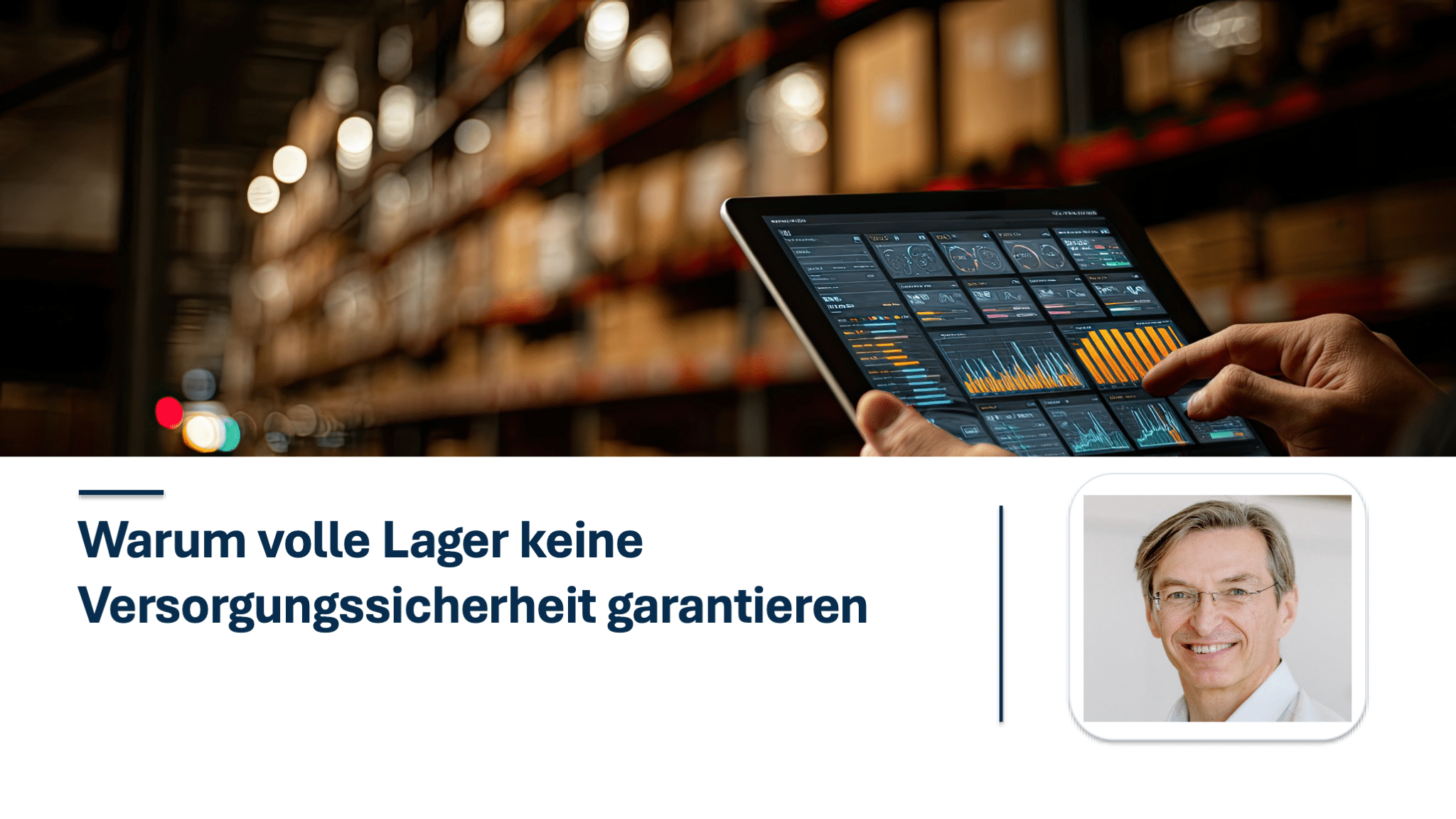
Why full warehouses do not guarantee security of supply
A company can have too much substance – and at the same time too little of what it really needs.
That sounds paradoxical. In practice, I encounter this exact situation time and again: Warehouses are full, a lot of capital is tied up, and yet the very parts that are crucial for production or customer orders are missing.
That was exactly the case in one of our projects.
At first glance, it looked like a problem with the inventory. However, closer analysis revealed that the real problem was not the quantity of material, but its composition.
Simply put:
It wasn't that there was too little in stock. The wrong thing was in stock.
The purchasing department is reporting record savings. Why aren't costs decreasing nonetheless?
The purchasing department reports six percent savings. At the same time, costs are rising by two percent.
Both can be correct.
Let's assume a supplier announces a price increase of eight percent. After intensive negotiations, only two percent remain. The purchasing department has successfully fended off six percentage points of the announced price increase – and thus made a significant economic contribution.
Nevertheless, the company ends up paying two percent more than before.
Did the purchase now save six percent?
Depending on the perspective, the answer varies. However, one thing is certain: the purchasing department has avoided a significant portion of the threatened cost increase.
This may initially seem like splitting hairs. In fact, it leads to a central question in cost management:
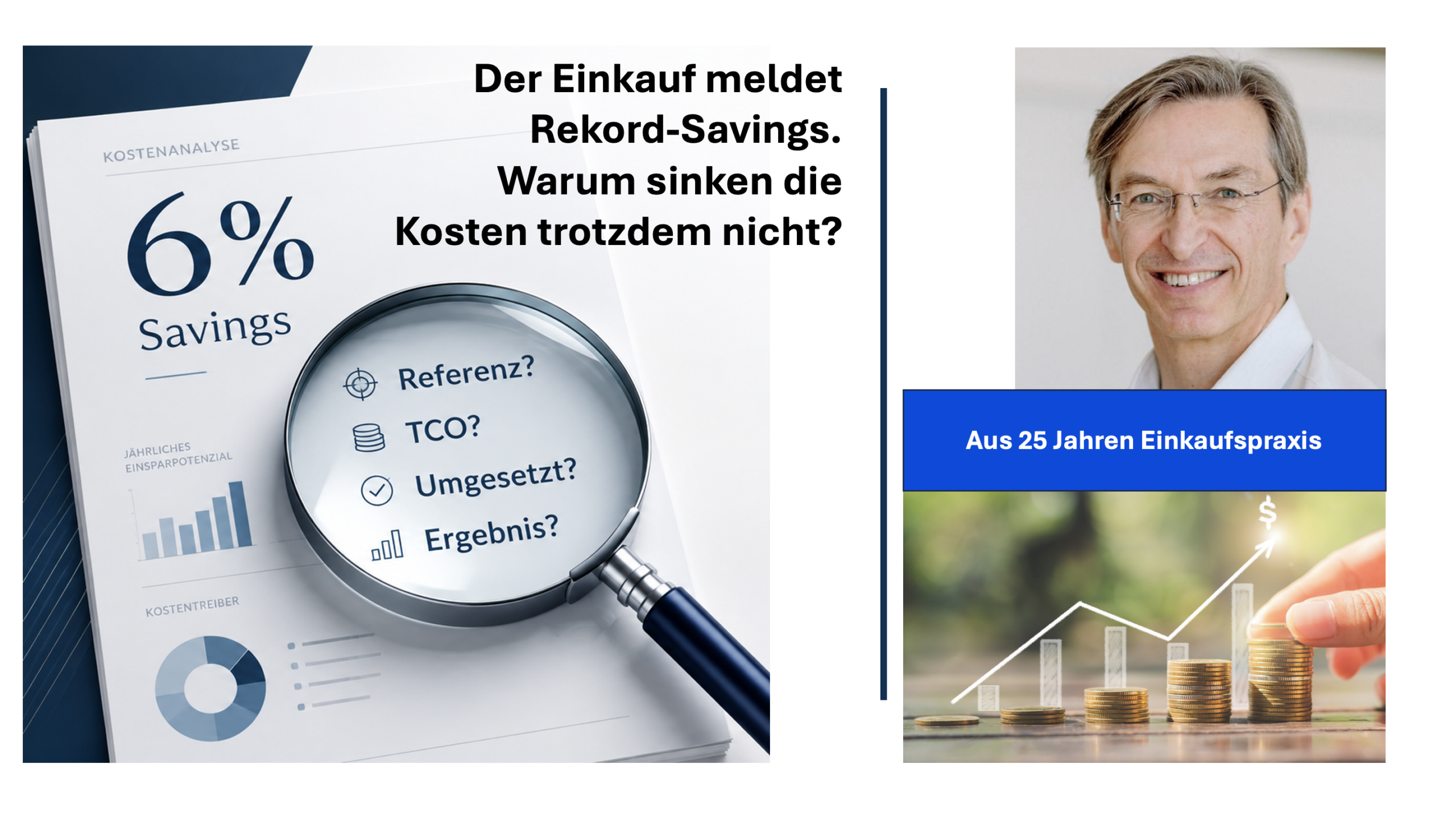
What exactly are we measuring when we talk about "savings"?
The turning point in purchasing negotiations is rarely the better argument.
We had already held several rounds of talks. Both sides were familiar with every demand, every counter-demand, and every argument. Despite this, nothing changed.
A fairly obvious reaction would have been to increase the pressure, negotiate even more aggressively, or present further arguments. I chose a different path.
When I took over the negotiation of software licenses in the seven-figure range for a large German corporation as an interim manager, it quickly became clear to me:
The problem wasn't the argumentation. What was lacking was a fresh perspective on the situation.

A negotiation alternative opened up.
My suggestion: From now on, our negotiating team will meet every morning for 15 minutes. No status reports. No task lists. No discussions.
Instead, we asked ourselves just one question: "Does anyone have a new idea that could help us move forward?"„
The initial reaction was subdued: "We don't come up with something new every day."„
But that's exactly what happened. Every morning brought new ideas. Eventually, the perspective on the problem changed. Until finally, someone on the team suggested an alternative procurement method – and with that, a genuine negotiating alternative opened up for the first time.
Suddenly we had something we had been missing until then: a choice.
At that moment, the dynamics changed completely. Not because we argued more convincingly, but because we had expanded our options.
The biggest mistake in purchasing negotiations
After more than 25 years in strategic purchasing, I have come to a conviction:
Most purchasing negotiations do not fail due to a lack of persuasiveness.
They stall because both sides think exclusively within the framework of their existing positions.
Those who have no alternative almost always negotiate from a weaker starting position. Those who develop new options, on the other hand, shift the balance of power – often without raising a single additional argument.
Therefore, for me, a successful negotiation strategy begins long before the actual negotiating table. It begins with a simple question: What possibilities are we not yet aware of?
What companies can learn from this
In our projects at Emarticon, we repeatedly experience that this is exactly where the biggest lever for successful purchasing negotiations lies.
What matters is not more sophisticated presentations or tougher negotiation techniques. What matters is the ability to systematically expand one's own room for maneuver.
Therefore, in complex procurement and supplier projects, we work with interdisciplinary teams, structured changes of perspective and creative thinking formats.
New opportunities rarely arise by chance or in quiet solitude. They can be developed deliberately, and best done as a team.
The real competitive advantage doesn't come from better arguments, but from better options. Expanding one's possibilities often changes the entire starting position – even before further negotiations begin.
In my experience, it's not the person with the most convincing arguments who wins in the end, but the one who has the better alternatives.
👉 Here you will find my negotiation model with the seven principles of successful purchasing negotiations – developed from more than 25 years of practical experience: → Emarticon negotiation model
AI myths in strategic purchasing: AI makes experience obsolete.
Many believe AI will replace experienced buyers. I believe the opposite.
The better AI becomes, the greater the value of experience.
At first glance, this sounds contradictory. After all, artificial intelligence now analyzes contracts, evaluates suppliers, monitors markets, and identifies risks in the supply chain within seconds. What used to require hours of research, AI now often accomplishes at the touch of a button.
This quickly leads to the assumption that long-standing experience in strategic purchasing will become less important in the future. But that is precisely where a misconception lies.

The value of experience is shifting
For a long time, experience in strategic procurement was primarily a knowledge advantage. Those who had worked in procurement for many years knew markets, suppliers, price trends, and typical risks better than others. This knowledge gave companies a decisive competitive edge.
With the digitalization of procurement and the use of AI, this situation is fundamentally changing. Information is becoming available to significantly more people. Analyses are being created faster, more comprehensively, and often more objectively than ever before. Competition is therefore shifting from information gathering to the ability to correctly classify information and derive sound purchasing decisions from it.
The value of experience does not disappear – it shifts. Previously, experience consisted primarily of knowing more. Today, it consists of being better able to assess which information is truly relevant and what consequences it has for one's own company.
Because AI doesn't make decisions. It provides the basis for decisions.
Whether a recommendation is useful always depends on the specific company, its purchasing strategy, its supply chain, its supplier management, its risk management, its customers, and its risk tolerance. This is precisely where the real task of strategic purchasing begins.
Experience builds judgment
Over the past few years, I've overseen numerous procurement projects – from medium-sized businesses to international corporations. Since we've increasingly integrated AI into analyses and decision-making processes, I've observed the same effect time and again: speed increases dramatically. At the same time, experience and judgment are becoming more important than ever.
At Emarticon, we naturally use AI as a tool today. At the same time, we have further developed our methods in strategic procurement. Because the more powerful analyses become, the more important the ability to correctly interpret their results and derive responsible decisions from them becomes.
An experienced buyer or purchasing manager doesn't necessarily know more than an AI. But they recognize when a recommendation seems logical but isn't the right solution in the specific business context. They assess conflicting objectives, consider business priorities, and take responsibility for the consequences of a decision.
Therefore, the requirements for strategic purchasing will change. In the future, the most important skill will be less about gathering information and more about asking the right questions.
For example:
- What assumptions underlie this recommendation?
- What information might be missing?
- Which risks are actually relevant to our supply chain?
- What impact will this decision have on our purchasing strategy?
- What priorities does this entail for the company?
Technical understanding in dealing with AI will naturally become a key competence in purchasing. However, the real competitive advantage lies elsewhere: in judgment.
People will not be successful in the future simply because they possess more information through AI. They will be successful when they critically examine results, interpret them meaningfully, and derive responsible decisions for purchasing, procurement, and the supply chain.
AI makes knowledge available more quickly. Experience determines what we do with it. In my view, this is precisely where the real competitive advantage of strategic purchasing lies in the age of AI.
More on this topic: → Purchasing strategies and AI in purchasing
The end of a comfortable China strategy.
Or: Why purchasing needs to be rethought right now.
We talk about tariffs all the time.
I believe the real race is already happening elsewhere.
It's no longer just about products.
It's about knowledge. More precisely: about access to knowledge.
This is precisely where the rules of the game for European purchasing are changing.
China has significantly restricted the transfer of sensitive technologies and know-how abroad through new regulations. Companies will only be allowed to share this knowledge under strict government guidelines.
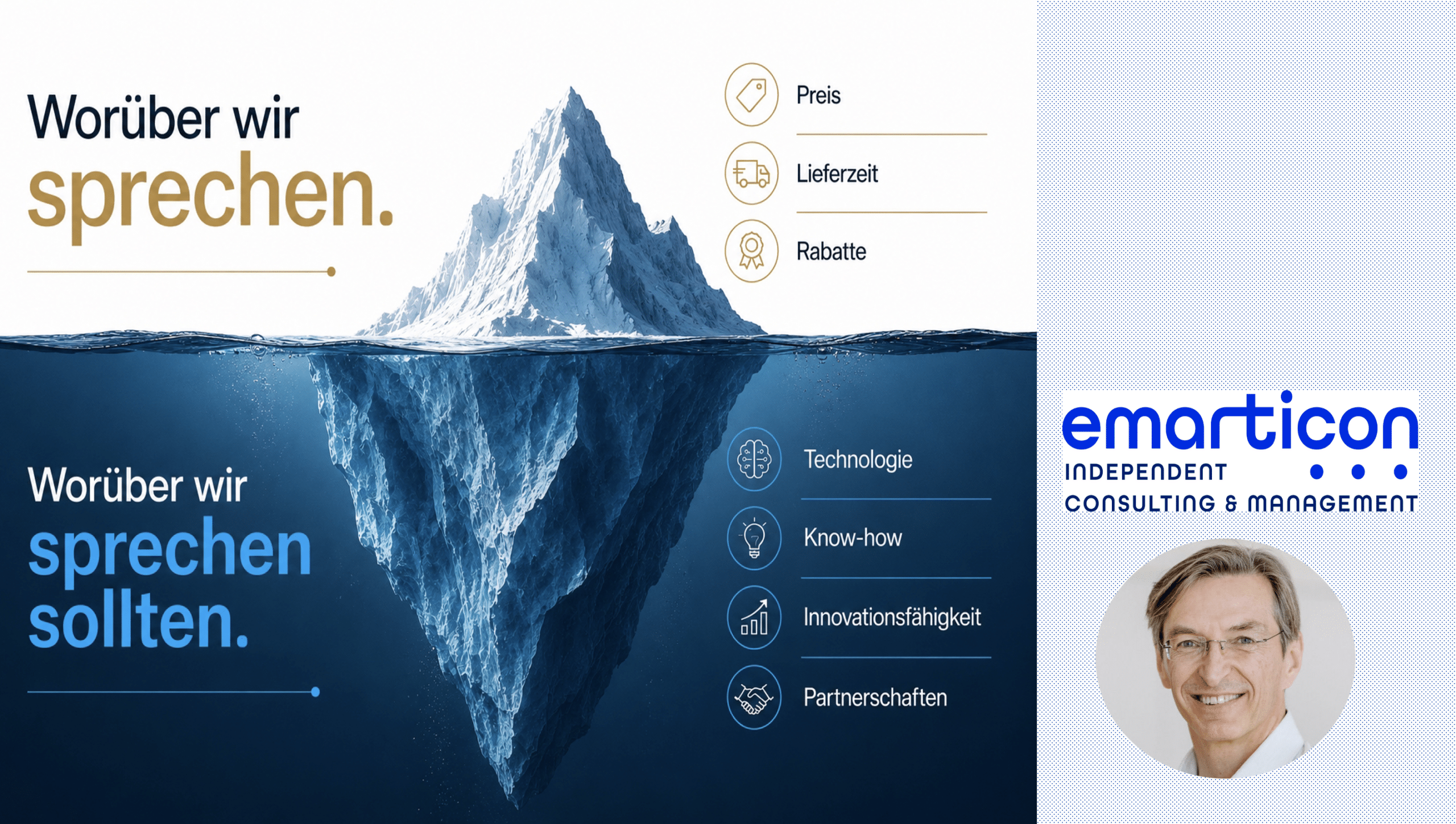
For me, this is far more than just another trade barrier.
It marks the end of a strategy that many European companies relied on for decades. For a long time, the roles were clearly defined: Europe brought technologies and manufacturing expertise to China. Those who wanted to produce there had to share their know-how. China used this knowledge, consistently developed it further, and today is among the innovation leaders in areas such as battery technology, electromobility, and artificial intelligence.
And it is precisely now that the direction of knowledge transfer is changing.
Access to this technological know-how is becoming more difficult. This affects not only individual companies, but also the competitiveness of entire industries.
Therefore, I am observing a trend in many procurement projects that is increasingly worrying me.
Purchasing decisions are still often defined primarily by prices, savings, and terms. This remains important – but it's no longer enough.
The crucial question today is no longer:
„"Where can we buy our groceries more cheaply?"“
Rather:
„"How do we secure long-term access to technology, innovation and know-how?"“
In my view, this fundamentally changes the role of purchasing.
Purchasing is evolving from a classic cost function to a strategic future function. He is increasingly playing a key role in deciding which technologies will be available to a company in the long term, how resilient the supply chain is, and how independently a company can position itself in critical areas.
This also changes the requirements for supplier evaluation.
In addition to price, quality and delivery capability, new criteria are gaining importance:
- What technological expertise does a supplier possess?
- How innovative is he?
- What dependencies arise?
- Which strategic partnerships make sense?
- What knowledge should we consciously build up ourselves within the company?
I am convinced that successful purchasing organizations will have to think much more broadly in the future.
Topics such as resilient procurement strategies, targeted know-how development and long-term technology partnerships are becoming central components of a modern purchasing strategy.
Perhaps that is precisely where the greatest change lies.
Hence, the Shopping secures Today, it's no longer just about supplying a company. It increasingly secures its... Future viability.
What does judo have to do with successful purchasing negotiations?
More than you might initially suspect.
I did judo for over 20 years, two of them as a member of the German national team. Back then, it was all about competitions for me – not negotiations. I never would have expected that the experiences from that time would shape my professional life so profoundly.
In judo, the stronger person rarely wins. Success often goes to the one who correctly assesses the situation, remains patient, and recognizes when an opportunity arises. Strength alone is not enough. Those who only try to defeat their opponent by force often make themselves predictable. Timing, technique, and the ability to correctly interpret the situation are crucial.
I still encounter these exact principles in purchasing negotiations today.

I repeatedly observe that negotiations escalate unnecessarily early. Both sides try to push through their position as quickly as possible, building pressure and arguing increasingly harshly. The problem is that those who focus solely on their own position often overlook the fact that the real opportunities only emerge as the negotiation progresses.
Decisive turning points often occur when a window of opportunity suddenly opens – because priorities shift, new information becomes available, or new solutions emerge. In negotiation, this is known as the "window of opportunity." Those who are prepared and recognize this moment often gain a decisive advantage.
However, a second principle is at least as important to me.
Address critical issues early
Many negotiations drag on unnecessarily because peripheral issues are discussed while the actual conflict of objectives remains unaddressed. Often, all parties involved know what the real issue is – yet no one speaks openly about it. This leads to misunderstandings, frustration, and frequently, rounds of negotiations that could have been avoided with honest communication.
I've therefore learned to address critical issues as early as possible – openly, respectfully, and with a focus on solutions. This doesn't mean seeking out conflict. On the contrary: making the actual conflict of objectives visible creates the conditions for resolving it together. My experience shows that this approach not only leads to greater transparency, faster decisions, and more sustainable agreements, but also often builds trust – because both sides know what they're really talking about.
Another thought has occupied me repeatedly over the past few years.
The best negotiators are good listeners
Many people assume that good negotiators are particularly quick-witted or always have to have the last word. I don't believe that. The best negotiators I've had the pleasure of meeting are characterized by something else. They listen attentively. They ask the right questions. And they first try to understand the other side's actual interests, constraints, and goals.
Because positions and interests are not the same thing.
One position might be: "We cannot accept this price." However, this could be driven by a variety of underlying interests – such as budget constraints, time pressure, internal processes, or strategic goals. Simply reacting to positions means negotiating only on the surface. Understanding the underlying interests often leads to solutions that were previously invisible.
That, for me, is one of the biggest differences between good and very good negotiators.
In over 25 years of project work in strategic procurement, I have repeatedly experienced this: Successful procurement negotiations are rarely decided by volume or maximum pressure. They arise from careful preparation, active listening, and a genuine understanding of the other side's interests.
Perhaps this is the most important parallel between judo and negotiation.
It's not about defeating the other person. It's about reading the situation correctly, recognizing opportunities, and seizing the right moment.
Successful purchasing negotiations are rarely made under pressure. What matters are preparation, timing, and the courage to address the actual conflict early on.
Do you want to make your purchasing a success factor?
I would be happy to discuss your specific situation with you in a personal conversation.